Spend an evening around comedians and you will hear words that sound normal but mean something specific. Someone “killed”. Someone else “ate it”. There was a great “callback”. This glossary explains the vocabulary in plain English.
On the bill
- Host, MC or compère
- The person who runs the night: warms up the crowd, introduces each comedian and keeps the energy going between sets.
- Opener
- The first act after the host. Often a shorter set.
- Headliner
- The main act, usually last and with the longest set.
- Showcase
- A night with several comedians each doing a short set.
- Open mic
- A night where anyone can sign up to perform, often new comedians testing material. Cheap or free to watch, and unpredictable. It is where most comedians start; we wrote about how independent shows in Madrid get made.
The material
- Bit
- A short routine on one subject.
- Set
- A comedian’s full performance on the night.
- Tight five
- Five minutes of a comedian’s strongest, most polished material. The calling card for booking spots.
- Premise
- The idea or observation a joke is built on.
- Set-up and punchline
- The set-up creates an expectation. The punchline breaks it.
- Tag
- An extra punchline added after the first one, getting another laugh from the same set-up.
- Callback
- A reference to an earlier joke later in the set. Audiences love them because they feel like an inside joke you are now part of.
- Crowd work
- Talking with the audience and improvising jokes from the answers. Our article on the front row and crowd work explains more.
How it went
- Killed / destroyed / smashed it
- The set went brilliantly.
- Bombed / died / ate it
- The set went badly. Every comedian has done it, many times.
- The room
- The audience as a whole, and the mood in the venue. “A tough room” is a quiet crowd.
- Heckler
- An audience member who interrupts uninvited. Not the same as answering a comedian’s question.
- Getting the light
- A signal, often a torch from the back, telling the comedian their time is nearly up.
Formats
- Improv
- Comedy made up on the spot, often from audience suggestions.
- Sketch
- Short scripted scenes with characters.
- Roast
- Jokes aimed at a willing target, usually a fellow comedian.
- Live podcast
- A recorded or podcast-style conversation performed in front of an audience.
For a fuller explanation of how these formats feel in the room, read what a mixed comedy night looks like.
Put the words to use
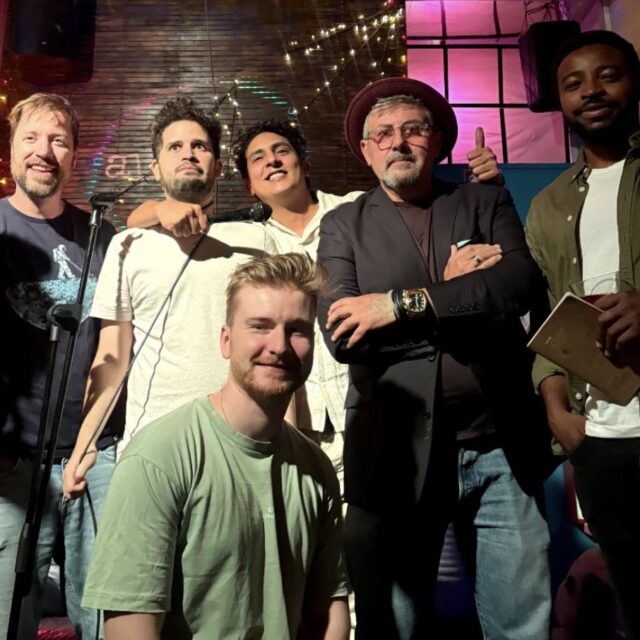
The best way to learn comedy vocabulary is to watch it live. At No Offense, But... you will see a host, stand-up sets, crowd work, live podcast moments and improv in one night, all in English at Off Latina in La Latina. If it is your first time, read our guide to what to expect at a comedy show, then pick a date on the what’s on page.